
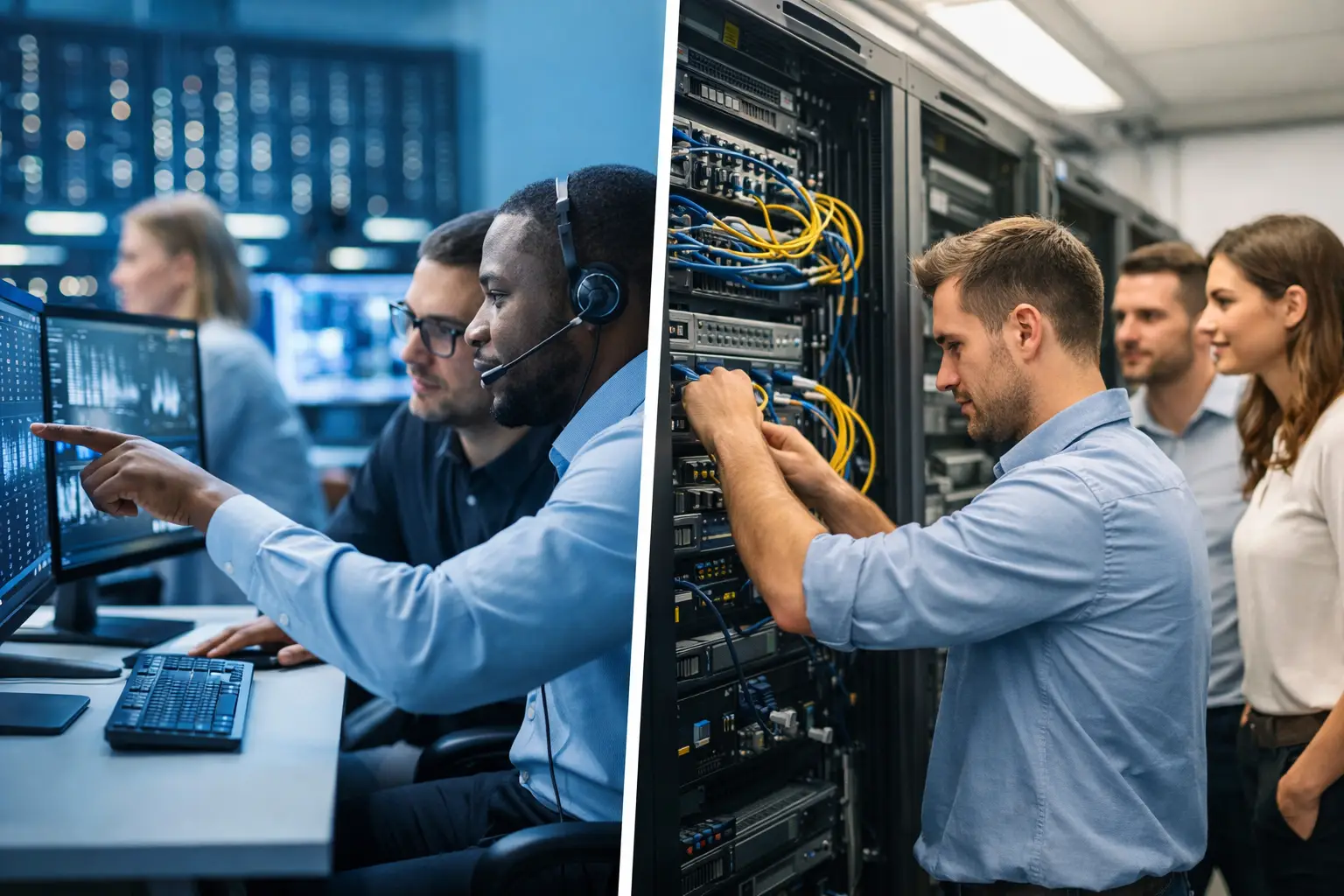
Managed IT vs In House: What Fits Best?
When your internet drops, your phones stop working, or a suspicious email slips past staff, the managed IT vs in house decision stops being theoretical. It becomes a business problem with a real cost attached to it. For small and mid-sized companies, the right choice usually comes down to one question: do you want to build and manage internal IT capacity yourself, or work with a partner that already has the tools, people, and processes in place?
There is no one-size-fits-all answer. Some businesses benefit from having an internal IT person on staff. Others get better coverage, stronger security, and more predictable costs from a managed services provider. The best fit depends on your size, complexity, risk tolerance, and how much time your leadership team wants to spend on technology.
Managed IT vs in house: the real difference
At a basic level, in-house IT means you hire employees to handle your systems internally. That may be one generalist, a small team, or a full department depending on your company size. They manage day-to-day support, upgrades, vendor coordination, security tasks, and infrastructure planning.
Managed IT means outsourcing some or all of those responsibilities to a specialized provider. Instead of relying on one or two internal staff members, you gain access to a broader team that can monitor systems, respond to issues, manage backups, support cybersecurity, maintain servers and networks, and help with planning.
The key difference is not just who fixes problems. It is who owns the process of keeping your business technology stable, secure, and current.
Cost is not just salary
Many businesses start this comparison by looking at payroll, and that makes sense. Hiring in-house means salary, benefits, vacation coverage, training, certifications, recruiting time, and the cost of turnover. If you only hire one person, you may also face a skills gap because no single employee is an expert in every area.
Managed IT is usually priced as a monthly service, a project fee, or a mix of both. That makes budgeting easier for companies that want predictable costs. It also shifts some operational burden away from your leadership team, because you are not building a technical department from scratch.
That said, the lowest monthly number is not always the best value. A business with highly specialized systems or round-the-clock operations may still need internal technical leadership. On the other hand, a company with 15 to 75 employees often finds that outsourced support gives them broader coverage for less than the cost of hiring a full internal team.
The better question is not, “Which is cheaper?” It is, “What level of support, protection, and response time are we actually getting for the money?”
Coverage and depth of expertise
This is where managed IT often has a clear advantage.
An internal IT person may be excellent at desktop support, vendor troubleshooting, and keeping day-to-day operations moving. But modern business technology is wider than it used to be. You may need help with firewall management, ransomware protection, backup verification, cloud systems, VoIP, wireless networks, compliance concerns, email security, remote access, and long-term planning.
That is a lot to place on one employee or even a small team.
A managed IT provider typically brings a wider bench of specialists. Instead of depending on one person to know everything, you have access to people with different strengths. That matters when a business is growing, moving offices, replacing servers, rolling out new communication systems, or trying to tighten security without overspending.
In-house IT can still work well if your company is large enough to support multiple roles. If you have a help desk technician, a systems administrator, a security lead, and an IT manager, you may have the internal depth needed. Most smaller organizations do not.
Speed, uptime, and accountability
Businesses rarely notice IT when everything is working. They notice it when something breaks at the wrong time.
In-house teams can be very responsive because they are on site and know the business well. They understand staff, workflows, and local equipment. That familiarity is valuable, especially in environments with specialized hardware or hands-on operational needs.
Managed IT providers, however, often bring stronger process discipline. They use monitoring systems, documented procedures, ticketing workflows, and escalation paths that many smaller internal teams simply do not have. Problems can be caught earlier, and recurring issues are less likely to be handled as one-off emergencies.
This is one of the biggest differences in the managed IT vs in house discussion. Internal IT can be close to the business. Managed IT can be broader, more structured, and less dependent on a single person being available.
If your current setup depends heavily on one employee who knows all the passwords, all the vendors, and all the workarounds, that is a risk. If that person leaves, gets sick, or goes on vacation, the business can be exposed fast.
Security changes the conversation
A few years ago, some companies could treat cybersecurity as an add-on. That is no longer realistic.
Today, even smaller organizations are targets for phishing, ransomware, credential theft, and data loss. Cybersecurity is not just about antivirus software. It involves layered protection, email filtering, backup strategy, patching, user access controls, firewall management, staff awareness, and response planning.
This is where many in-house models start to struggle. Not because internal teams are careless, but because security work is constant. It needs attention, tools, reporting, and specialized knowledge. If your internal IT person is already buried in printer issues, device setup, and user support, security can become reactive instead of proactive.
Managed IT providers are often better positioned to deliver ongoing protection because security is part of the service model. They can monitor, update, assess, and respond as part of a larger operational plan.
For many businesses, that alone shifts the balance toward outsourcing. The cost of one serious security incident can wipe out any savings gained by underinvesting in support.
Strategy matters as much as support
A lot of IT conversations focus on fixing problems. The better question is whether your technology is actually supporting the business.
If your systems are slow, your backups are unreliable, your communications tools are fragmented, or your staff is working around outdated processes, then IT is no longer just a support function. It is affecting productivity and customer experience.
A strong in-house IT leader can absolutely help with strategy. The challenge is that smaller businesses often do not hire at that level. They hire for support needs and hope strategy will follow.
Managed IT providers can help fill that gap by bringing planning into the relationship. That includes assessing what you have, identifying weak points, recommending upgrades in the right order, and helping you avoid expensive missteps. This is especially useful for businesses that want practical guidance instead of a patchwork of vendors.
That broader view is one reason companies work with providers like Schneiders MSP. The value is not just in troubleshooting. It is in having one partner who can assess needs, recommend a workable solution, manage the rollout, and support the environment afterward.
When in-house IT makes sense
In-house IT is often the right choice if your company is large enough to support multiple technical roles, has highly specialized systems, or needs full-time on-site coverage every day. It can also make sense if technology is deeply embedded in your operations and requires constant internal coordination.
This model works best when you can invest properly. That means enough staff to avoid key-person risk, enough budget for training and tools, and enough leadership attention to set direction.
If you underbuild an internal IT function, you may end up with the drawbacks of both models: higher payroll costs without full coverage.
When managed IT makes sense
Managed IT is often the better fit for businesses that need reliable support, stronger security, and predictable costs without hiring a full internal team. It is especially valuable for growing companies, multi-location businesses, and organizations that want access to a wider range of skills.
It also makes sense when leadership wants technology handled professionally but does not want to spend time managing vendors, approving every technical decision, or reacting to recurring issues.
For many small and mid-sized businesses, outsourced IT support gives them enterprise-level structure in a format that fits their budget.
The hybrid model is often the smartest answer
This does not always have to be an either-or decision.
Many businesses get the best results from a hybrid approach. They keep an internal point person or IT manager who understands the business, then use a managed IT provider for monitoring, security, backups, vendor coordination, escalations, and project work.
That setup can be practical and cost-effective. Your internal team focuses on business-specific needs while your provider adds depth, coverage, and specialized support. It also reduces dependency on one person and gives leadership better continuity.
If you are weighing managed IT vs in house, start with an honest look at where your current setup is thin. If security is inconsistent, support is reactive, projects keep stalling, or too much knowledge sits with one employee, those are signs your model may need to change. The right IT structure should make your business easier to run, not harder to protect.