
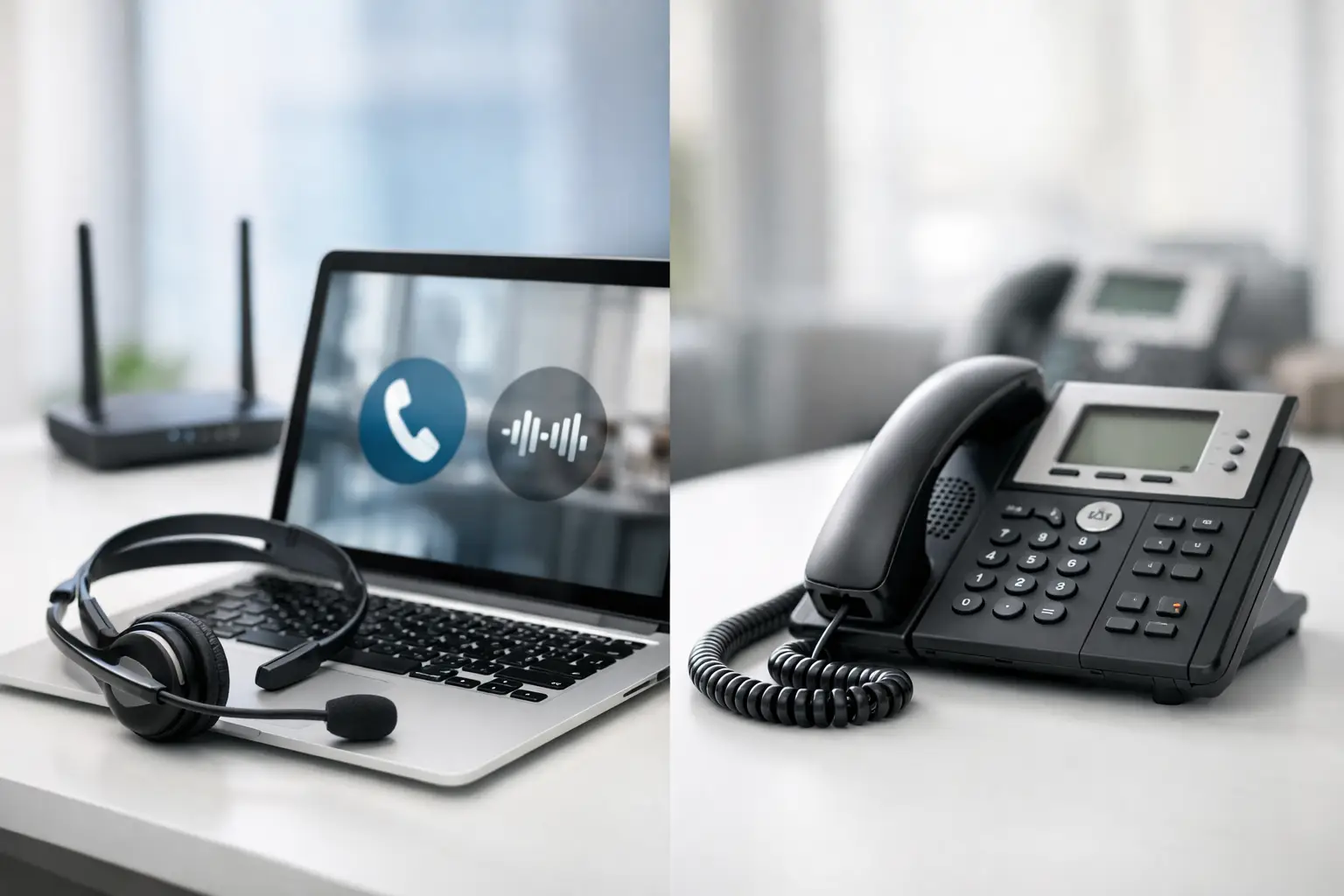
VoIP vs Traditional Phone Systems
When a business phone system starts causing missed calls, unclear audio, or surprise repair costs, the question gets practical fast. VoIP vs traditional phone systems is not just a technology comparison – it is a decision about monthly costs, flexibility, reliability, and how well your team can keep working when business gets busy.
For small and mid-sized businesses, the right answer usually depends on how your staff works day to day. A front desk that rarely changes has different needs than a mobile sales team, a multi-location office, or a company trying to control costs without giving up call quality. The best phone system is the one that fits your operation, not the one with the longest feature list.
What separates VoIP and traditional phone systems?
Traditional phone systems use physical phone lines through the public switched telephone network. In many businesses, that means desk phones connected through copper lines or legacy PBX equipment on-site. The setup is familiar, and for years it was the default choice because it was stable and straightforward.
VoIP, or Voice over Internet Protocol, sends calls over your internet connection instead of dedicated phone lines. That changes more than just the wiring. It affects how your business adds users, supports remote staff, manages phone features, and handles long-term costs.
The biggest difference is flexibility. Traditional systems are tied more closely to physical infrastructure. VoIP is software-driven, which makes it easier to scale, update, and manage across different locations or devices.
VoIP vs traditional phone systems for cost
Cost is often the first place business owners look, and for good reason. A traditional phone system can involve line charges, hardware maintenance, service calls, and expansion costs when your team grows. If you are working with older PBX hardware, repairs and replacement parts can become a real issue over time.
VoIP often lowers those costs, especially for businesses that already have dependable internet service. Monthly billing is usually more predictable, and adding a user is simpler than installing another physical line. Long-distance and multi-location calling can also be much less expensive.
That said, VoIP is not automatically the cheapest option in every case. If your network is outdated, you may need upgrades to switches, firewalls, or bandwidth to support call quality. Businesses that move too quickly without checking their network can end up blaming the phone system for problems that really come from weak infrastructure.
This is where a proper assessment matters. A lower monthly phone bill looks good, but it only pays off if the system works consistently under real business conditions.
Reliability depends on what your business can support
Many people still assume traditional phones are more reliable simply because they have been around longer. In some situations, that assumption holds up. Legacy phone lines can continue working during certain internet outages, and businesses that rely on a very basic setup may appreciate that simplicity.
But reliability today is not just about whether a dial tone exists. It is about whether your staff can answer calls, transfer them properly, access voicemail, and stay reachable from wherever they work. In that broader sense, VoIP can be extremely reliable when it is built on a solid network and supported correctly.
If your internet connection is unstable, VoIP will suffer. Poor bandwidth management, old networking equipment, and weak internal Wi-Fi can lead to dropped calls, delay, or jitter. On the other hand, a well-designed VoIP environment with quality internet, failover planning, and business-grade hardware can outperform an aging traditional system that is expensive to maintain and difficult to expand.
So the better question is not which option is more reliable in theory. It is which one will be more reliable in your actual environment.
Features are where VoIP usually pulls ahead
Traditional systems still work for businesses that only need basic calling. If your team answers calls from a single location, transfers a few extensions, and does not need much else, a simple traditional setup may still be enough.
VoIP tends to win when businesses want modern features without adding complexity. Auto attendants, voicemail to email, mobile apps, call routing, hunt groups, call recording, analytics, and easy user management are commonly available. These tools are especially useful for growing companies that want a more professional call experience without investing in heavy on-site equipment.
That matters operationally. A missed call can mean a missed sale, a delayed service request, or a frustrated customer. Features that help calls reach the right person quickly can have a direct impact on response time and customer service.
For businesses with hybrid or remote staff, the gap gets even wider. VoIP makes it much easier for employees to use the business number from laptops, desktops, or mobile devices. Traditional systems can support remote access in some cases, but usually with more effort and less flexibility.
Installation, scaling, and ongoing management
Traditional phone systems can be harder to change once they are in place. Adding extensions, moving phones, or opening another office may require on-site work, new cabling, or added hardware. If your business is stable and unlikely to change much, that may not be a problem. If you are growing or restructuring, it can become one.
VoIP is generally easier to scale. New users can often be added quickly, and changes can be managed through software rather than physical rewiring. This is one reason many small and mid-sized businesses move to VoIP when they want room to grow without rebuilding their communications setup every time the team changes.
Management also tends to be simpler with the right provider. Instead of juggling separate vendors for phones, internet, and IT support, many businesses benefit from having one team assess the environment, recommend the right setup, and handle the rollout from start to finish. That reduces finger-pointing when issues come up and makes support easier for your staff.
Security and business continuity deserve more attention
Phone decisions used to focus mostly on cost and call quality. Today, security and uptime need to be part of the conversation too.
Traditional systems are not automatically secure just because they are older. Legacy equipment can be difficult to patch, monitor, or integrate with modern security practices. VoIP introduces its own risks, especially if it is deployed without proper network security, access controls, and monitoring. But it also fits more naturally into a broader managed IT and cybersecurity strategy.
If your phones run over your network, then your network health matters. Firewall configuration, traffic prioritization, backup connectivity, and endpoint management all play a role in call performance and availability. That is why phone planning should not happen in isolation. It works best when it is part of a larger conversation about your infrastructure, internet reliability, and business continuity.
For many organizations, the real benefit of VoIP is not just better calling. It is having a communication system that can continue functioning even when staff are working remotely, a location is down, or calls need to be rerouted quickly.
Which businesses still make sense for traditional phones?
There are still cases where traditional systems fit. A very small office with minimal calling needs, limited internet quality, and no expectation of mobility may do fine with a basic legacy setup. Some industries also keep traditional lines for alarm systems, faxing, elevator phones, or backup purposes.
If you already have a functioning traditional system and it is meeting your needs at a reasonable cost, replacing it immediately may not be necessary. Not every business needs the newest platform right away.
Still, the longer-term question is supportability. As older systems age out, repairs become harder, providers phase out legacy services, and expansion becomes more expensive. A system that works today may still create limits tomorrow.
When VoIP is usually the better business decision
VoIP is often the stronger choice for businesses that want flexibility, lower overhead, easier scaling, and modern call handling. It is especially useful if your team works across offices, from home, or on the road. It also makes sense when you are already reviewing internet, security, or IT infrastructure and want your phone system to align with the rest of your technology.
For a lot of growing organizations, the biggest advantage is not one feature. It is the ability to stop treating phones as a standalone utility and start treating them as part of daily operations. When your communication tools match how your team actually works, everything gets easier to manage.
That is why the best approach is usually consultative, not one-size-fits-all. A provider like Schneiders MSP can look at your network, usage patterns, budget, and growth plans and recommend a setup that makes sense now without boxing you in later.
If you are weighing VoIP vs traditional phone systems, the smartest move is to look beyond the line item on the monthly bill. Think about how your business answers calls, supports staff, handles downtime, and plans for growth. The right system should make your day easier, not give you one more thing to manage.